
OSS Simple Sabotage Field Manual, part 1 of 7
Also on Spotify, Apple Podcasts, YouTube
Chosen by Brett.
From OSS Simple Sabotage Field Manual. Out Nov 14, 2026.
Read the transcript
Hello and welcome to Mike Check Stories. I'm your host, Brett Thorson. We've been
starting off this new podcast reading from the Last Whole Earth catalog. Hope
you've enjoyed that. We're going to do something a little different tonight. We're
going to start our unclassified bedtime stories. We're going to start with the
OSS Sabotage Field Manual. OSS is the precursor to the CIA. One of the places I
used to work, it was a lot of fun. Very smart people, good mission, interesting
place to work, taught me a lot. And when one of my set of co-workers mentioned
that it seems one of our managers, not at the CIA in a later job, was behaving as
if they were reading from the manual. I went and grabbed a copy of it. And sure
enough, I've had plenty of bad managers that seem to have actually read from the
manual and are executing straight from it. So I thought it'd be fun if we read
this together and put you to sleep. We're going to break this up into seven parts.
We're going to do this intro today and going to read through page three and
then we'll split it up into some other parts, the last part being the one
about managers. So if you really want to know about that, you can skip to the
end. I thought I'd share one of the things we do in the intelligence community
and in the DOD are these challenge coins. And because I'm still packing and
unpacking, I couldn't actually find any of my agency challenge coins, but this is
one that I got from a friend of mine who was an Air Force One pilot. So this
is a... it's unusual. I've never seen one. I guess that's a hexagon and shaped quite
like this. So I thought it was quite interesting. It was the 30th anniversary
of the of the Flying White House. It says right up there. There's actually two
planes. They're both modified bowings. So they're VC 25A's and these have flown
both George Bush's, Bill Clinton, Barack Obama, and Donald Trump. So usually they
have... when one is flying, the other one is usually stationed nearby as a backup. So
if anything happens, they can quickly swap it out. And this one even has things on
the side. So anytime beyond perfection is presidential quality.
Perfection is the minimum expectation. Anything beyond perfection is presidential
quality. Perfection is the minimum expectation. The tour that I went on, it
was for someone's retirement. And the tour took over 90 minutes just to go
through the different parts of Air Force One. It was pretty incredible. So if you do
ever happen to get invited to something like that, jump on the chance. It is
amazing what that plane can do and what's inside of it and how it's laid out in
everything. And the history of it too. And just like any part of the DOD, the
people who are part of that airlift are amazing. Just such professionals at
their job. Anyway, let's get into the declassified OSS Simple Sabotage Field
Manual.
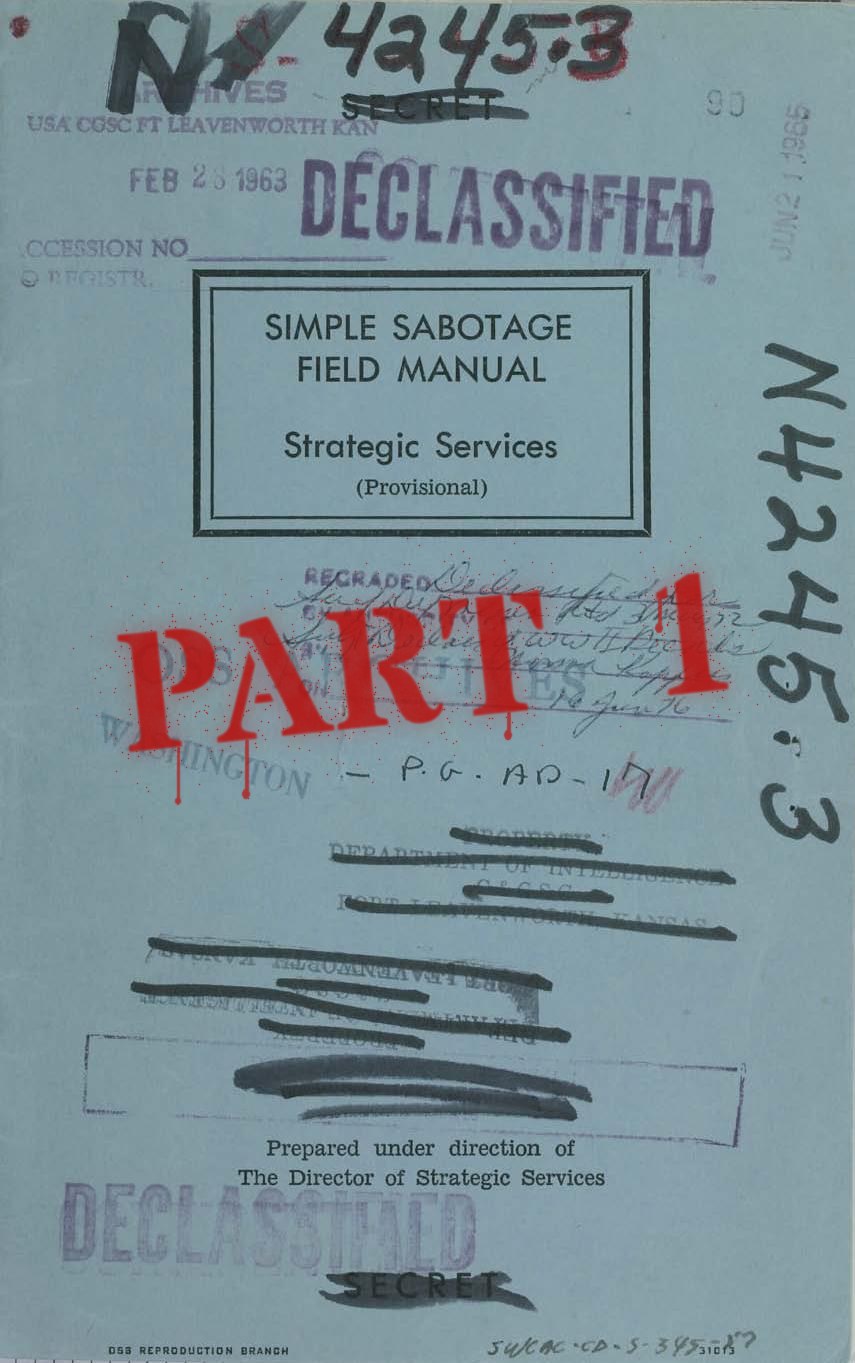
Prepared under the direction of the Director of Strategic Services. Simple
Sabotage Field Manual. Strategic Services, Provisional. Strategic Services
Field Manual, number three. Office of Strategic Services, Washington DC, 17
January 1944. The Simple Sabotage Field Manual, Strategic Services, Provisional,
is published for the information and guidance of all concerned and will be
used as the basic doctrine for Strategic Services training for this
subject. The contents of this manual should be carefully controlled and
should not be allowed to come into unauthorized hands. The instructions
may be placed in separate pamphlets or leaflets according to categories of
operations, but should be distributed with care and not broadly. They
should be used as a basis of radio broadcasts only for local and special
cases and as directed by the theater commander. AR 380-5, pertaining to
handling of secret documents, will be complied with in the handling of this
manual. William J. Donovan, Director.
Contents. Introduction, page one. Two, possible effects, page two. Three,
motivating the saboteur, page two. Four, tools, targets and timing, page six. Five,
specific suggestions for Simple Sabotage, page eight. Simple Sabotage,
Introduction, one, A. The purpose of this paper is to characterize Simple
Sabotage, to outline its possible effects and to present suggestions for
inciting and executing it. B, Sabotage varies from highly technical coup
de main acts that require detailed planning and the use of specially
trained operatives to innumerable simple acts which the ordinary
individual citizen saboteur can perform. This paper is primarily
concerned with the latter type. Simple Sabotage does not require
specially prepared tools or equipment. It is executed by an
ordinary citizen who may or may not act individually and without the
necessity for active connection with an organized group. And it is
carried out in such a way as to involve the minimum danger of
injury, detection and reprisal. C, where destruction is involved,
the weapons of the citizen saboteur are salt,
nails, candles, pebbles, thread or any other materials he might
normally be expected to possess as a householder or as a worker in
his particular occupation. His arsenal is the kitchen shelf,
the trash pile, his own usual kit of tools and supplies. The
targets of his Sabotage are usually objects to which he has
normal and inconspicuous access in everyday life. D, a second
type of simple sabotage requires no destructive tools
whatsoever and produces physical damage, if any, by highly
indirect means. It is based on universal opportunities to make
faulty decisions, to adopt a non-cooperative attitude and to
induce others to follow suit. Making a faulty decision may be
simply a matter of placing tools in one spot instead of
another. A non-cooperative attitude may involve nothing
more than creating an unpleasant situation among one's
fellow's workers, engaging in bickerings or displaying
surliness and stupidity. E, this type of activity
sometimes referred to as the human element is frequently
responsible for accidents, delays and general obstruction
even under normal conditions. The potential saboteur
should discover what types of faulty decisions
and uncooperation are normally found in this kind of work
and should then devise his sabotage so as to enlarge
that margin for error. Two, possible effects.
A, acts of simple sabotage are occurring throughout Europe.
An effort should be made to add their efficiency
lessen their detectability and increase their number.
Acts of simple sabotage multiplied by thousands of citizen saboteurs
can be an effective weapon against the enemy. Slashing tires,
draining fuel tanks, starting fires, starting arguments,
acting stupidly, short-circuiting electric systems,
abrading machine parts, will waste materials,
manpower and time. Occurring on a wide scale,
simple sabotage will be a constant and tangible drag on the war effort of
the enemy. B, simple sabotage may also have
secondary results of more or less value.
Widespread practice of simple sabotage will harass
and demoralize enemy administrators and police.
Further, success may embolden the citizen saboteur
eventually to find colleagues who can assist him in sabotage of greater
dimensions. Finally, the very practice of simple
sabotage by natives in enemy or occupied territory
may make these individuals identify themselves actively
with the United Nations war effort and encourage them to assist openly in
periods of allied invasion and occupation.
Three, motivating the saboteur. A, to incite the citizen
to the active practice of simple sabotage and to keep him practicing
that sabotage over sustained periods is a special problem.
B, simple sabotage is often an act which the citizen performs according to his own
initiative and inclination. Acts of destruction do not bring him
any personal gain and may be completely foreign to his
habitually conservationist attitude towards materials and tools.
Purposeful stupidity is contrary to human nature.
He frequently needs pressure, stimulation or assurance
and information and suggestions regarding feasible methods of simple sabotage.
One, personal motives. A, the ordinary citizen very probably has no immediate
personal motive for committing simple sabotage.
Instead, he must be made to anticipate indirect personal gain
such as might come with enemy evacuation or destruction
of the ruling government group. Gains should be stated as specifically as
possible for the area addressed. Simple sabotage will hasten the day when
Commissioner X and his deputies Y and Z will be thrown out
when particularly obnoxious decrees and restrictions will be abolished
when food will arrive and so on.
Abstract verbalizations about personal liberty,
freedom of the press and so on will not be convincing in most parts of the world.
In many areas they will not even be comprehensible.
B, since the effect of his own acts is limited the saboteur may become
discouraged unless he feels that he is a member of a large
though unseen group of saboteurs operating against the enemy
or the government of his own country and elsewhere.
This can be conveyed indirectly. Suggestions which he reads and hears can
include observations that a particular technique has
been successful in this or that district.
Even if the technique is not applicable to his surroundings
another's success will encourage him to attempt similar acts.
It also can be conveyed directly. Statements praising the effectiveness
of simple sabotage can be contrived which will be published by white radio,
freedom stations and the subversive press.
Estimates of the proportion of the population engaged in sabotage can be
disseminated. Instances of successful sabotage already
are being broadcast by white radio and freedom stations
and this should be continued and expanded where compatible with
security. C, more important than A or B would be to
create a situation in which the citizen saboteur acquires a sense of
responsibility and begins to educate others in simple sabotage.
Well thank you for coming along with me on this journey
as we read the OSS simple sabotage manual.
We have six more parts coming up. If you would like to
dedicate any of these pages to anyone that you know
there are links on the website micchecksdories.com
and you can either request some yourself or dedicate to someone else.
I'd love to hear from you. Until then have a good night.
Good sleep.
U.S. government document. Public domain.