
OSS Simple Sabotage Field Manual, part 4 of 7
Also on Spotify, Apple Podcasts, YouTube
Part 4 of 7. Picks up where part 3 left off.
From OSS Simple Sabotage Field Manual. Out Nov 25, 2026.
Read the transcript
Hello. I'm Brett Thorson, your host for Mike Check Stories. Today we'll be doing part four of our series,
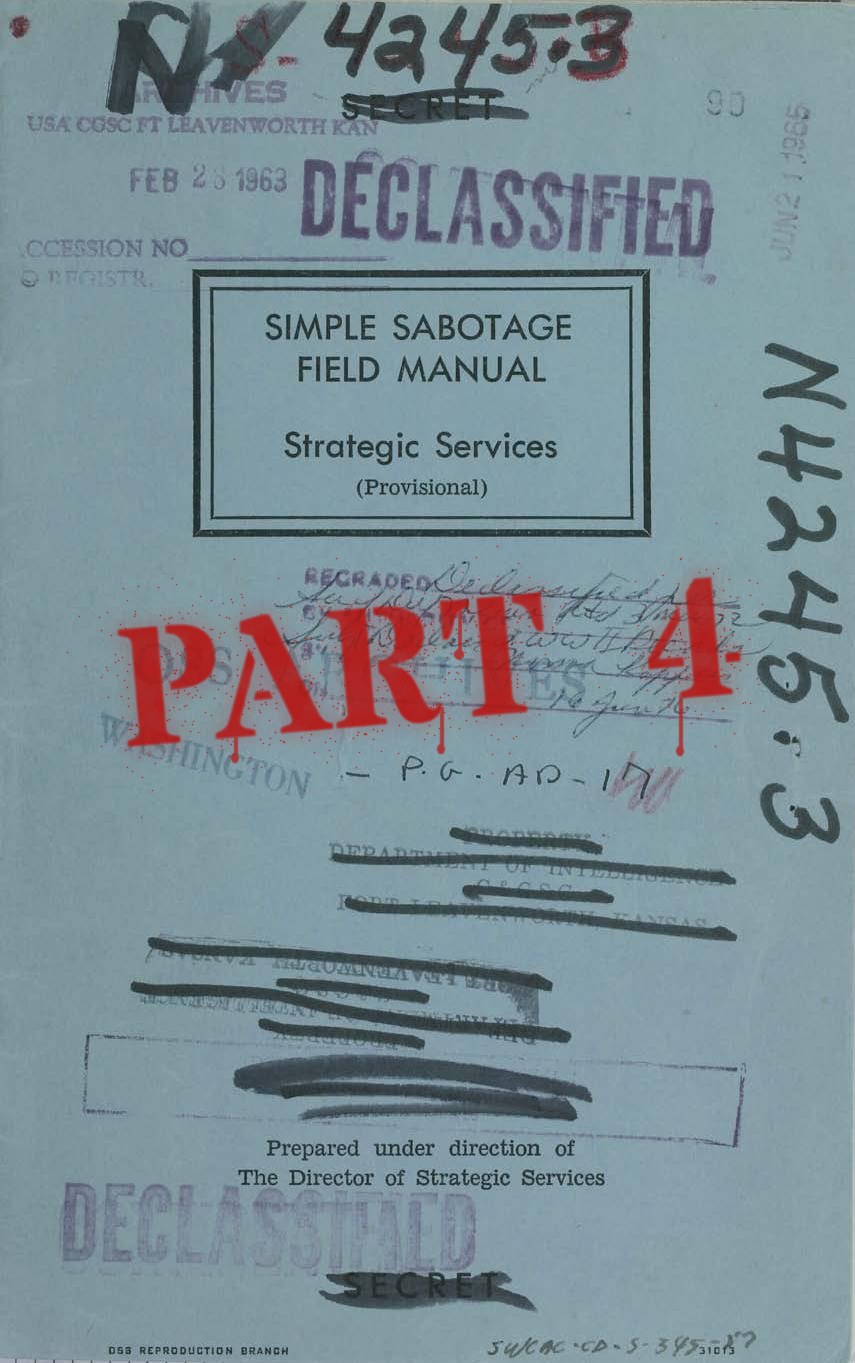
reading the Simple Sabotage Field Manual from 1944, published by the OSS, Office of Strategic Services,
The Precursor to the CIA. If you'd like to see any of the previous parts, you can head over to Mike Check Stories
or check them out on Apple Podcasts, YouTube, and Spotify. If you want to dedicate any of the future
readings to someone you know or yourself, feel free to head over to the website and just click a few
buttons and we can make that happen. For now, let's get into page 12 of the Simple Sabotage Field
Manual, published in 1944.
B. Oil and lubrication systems are not only vulnerable to easy sabotage but are critical in every machine
with moving parts. Sabotage of oil and lubrication will slow production or stop work entirely
as strategic points in industrial processes. 1. Put metal dust or filings, fine sand, ground glass,
emery dust, get it by pounding up an emery knife sharpener, and similar hard, gritty substances
directly into lubrication systems. They will scour smooth surfaces, ruining pistons, cylinder walls,
shafts, and bearings. They will overheat and stop motors, which will need overhauling, new parts,
and extensive repairs. Such materials, if they are used, should be introduced into lubrication
systems past any filters which otherwise would strain them out. 2. You can cause wear on any
machine by uncovering a filter system, poking a pencil or other sharp object through the filter mesh
then covering it up again. Or, if you can dispose of it quickly, simply remove the filter.
3. If you cannot get at the lubrication system or filter directly, you may be able to lessen the
effectiveness of oil by diluting it in storage. In this case, almost any liquid will do, which
will thin the oil. A small amount of sulfuric acid, varnish, water glass, or linseed oil will be
especially effective. 4. Using a thin oil where a heavy oil is prescribed will break down a
machine or heat up a moving shaft so that it will freeze and stop. 5. Put any clogging
substances into lubrication systems or, if it will float, into stored oil. Twisted comings
of cumin hair, pieces of string, dead insects, and many other common objects will be effective
in stopping or hindering the flow of oil through feedlines and filters. 6. Under some circumstances
you may be able to destroy oil outright rather than interfere with its effectiveness by
removing stop plugs from lubricating systems or by puncturing the drums and cans in which
it is stored. 7. See cooling systems. 1. A water cooling system can be put out of commission
in a fairly short time with considerable damage to an engine or motor if you put it into several
pinches of hard grain, such as rice or wheat. They will swell up and choke the circulation
of water, and the cooling system will have to be torn down to remove the obstruction. Sawdust
or hair may also be used to clog a water cooling system. 2. If very cold water is quickly
introduced into the cooling system of an overheated motor, contraction and considerable
strain on the engine housing will result. If you can repeat the treatment a few times,
cracking and serious damage will result. 3. You can ruin the effectiveness of an air
cooling system by plugging dirt and waste into intake or exhaust valves. If a belt
run fan is used in the system, make a jagged cut at least half way through the
belt. It will slip and finally part under strain and the motor will overheat.
4. Gasoline and oil fuel. Tanks and fueling engines usually are accessible
and easy to open. They afford a very vulnerable target for simple sabotage
activities. 1. Put several pinches of sawdust or hard grain such as rice or
wheat into the fuel tank of a gasoline engine. The particles will choke a feed
line so that the engine will stop. Some time will be required to discover the
source of the trouble. Although they will be hard to get, crumbs of natural
rubber such as you might find in old rubber bands and pencil erasers are
also effective. If you can accumulate sugar, put it in the fuel tank of a
gasoline engine. As it burns together with the gasoline, it will turn into a
sticky mess which will completely mire the engine and necessitate extensive
cleaning and repair. Honey and molasses are as good as sugar. Try to use about
75 to 100 grams for each 10 gallons of gasoline. 3. Other impurities which you
can introduce into gasoline will cause rapid engine wear and eventually
will break down. Fine particles of pumice, sand, ground glass and metal dust can
easily be introduced into a gasoline tank. Be sure that the particles are very
fine so that they will be able to pass through the carburetor jet.
4. Water, urine, wine or any other simple liquid you can get in reasonably
large quantities will dilute gasoline fuel to a point where no combustion
will occur in the cylinder and the engine will not move. One pint to 20 gallons
of gasoline is sufficient. If salt water is used it will cause corrosion
and permanent motor damage. 5. In the case of diesel engines, put low flash point
oil into the fuel tank. The engine will not move. If there already is
proper oil in the tank when the wrong kind is added the engine will only
limp and sputter along. 6. Fuel lines to gasoline and oil engines frequently
pass over the exhaust pipe. When the machine is at rest you can stab a small
hole in the fuel line and plug the hole with wax. As the engine runs
and the exhaust tube becomes hot the wax will be melted. Fuel will
start to drip onto the exhaust and a blaze will start. 7. If you have
access to a room where gasoline is stored remember that gas vapor accumulating
in a closed room will explode after a time if you leave a candle burning in
the room. A good deal of evaporation however must occur from the gasoline
tins into the air of the room. If removal of the tops of the tins
does not expose enough gasoline to the air to ensure copious
evaporation you can open lightly constructed tins further with a knife,
ice pick or sharpened nail file or puncture a tiny hole in the tank
which will permit gasoline to leak out on the floor. This will greatly
increase the rate of evaporation. Before you light your candle be sure
that windows are closed and the room is as air tight as you
can make it. If you can see that windows in a neighboring room are
opened wide you have a chance of setting a large fire which will
not only destroy the gasoline but anything else nearby. When the
gasoline explodes the doors of the storage room will be blown open.
A draft of the neighboring windows will be created which will whip
up a fine conflagration. E. Electric motors. Electric motors
including dynamos are more restricted than the targets so far
discussed. They cannot be sabotaged easily or without risk of injury
by unskilled persons who may otherwise have good opportunities
for destruction. One, set the re-estat to a high point of
resistance in all types of electric motors. They will overheat
and catch fire. Two, adjust the overload relay to a very high
value beyond the capacity of the motor. Then overload the motor
to a point where it will overheat and break down.
Three, remember that dust, dirt and moisture are enemies of
electrical equipment. Spill dust and dirt onto the points
where the wires in electric motors connect with terminals
and onto insulating parts. Inefficient transmission of current
and in some cases short circuits will result. Wet generator motors
to produce short circuits. Four, accidentally bruise the insulation
on wire, loosen nuts on connections, make faulty splices
and faulty connections in the wiring to waste electric current
and reduce the power of electric motors.
Well, this ends part four. We're just about halfway through,
we're a little over halfway through reading the OSS
Simple Sabotage Field Manual from the Office of Strategic Services
published in 1944. If you'd like to dedicate one of these
readings to someone or you'd like to jump ahead
or you'd like to see a page in the catalog
or just leave feedback, I'd love to hear from you
at mikecheckstories.com. I'm your host, Brett Thorsen.
Have a good night and good sleep.
U.S. government document. Public domain.