
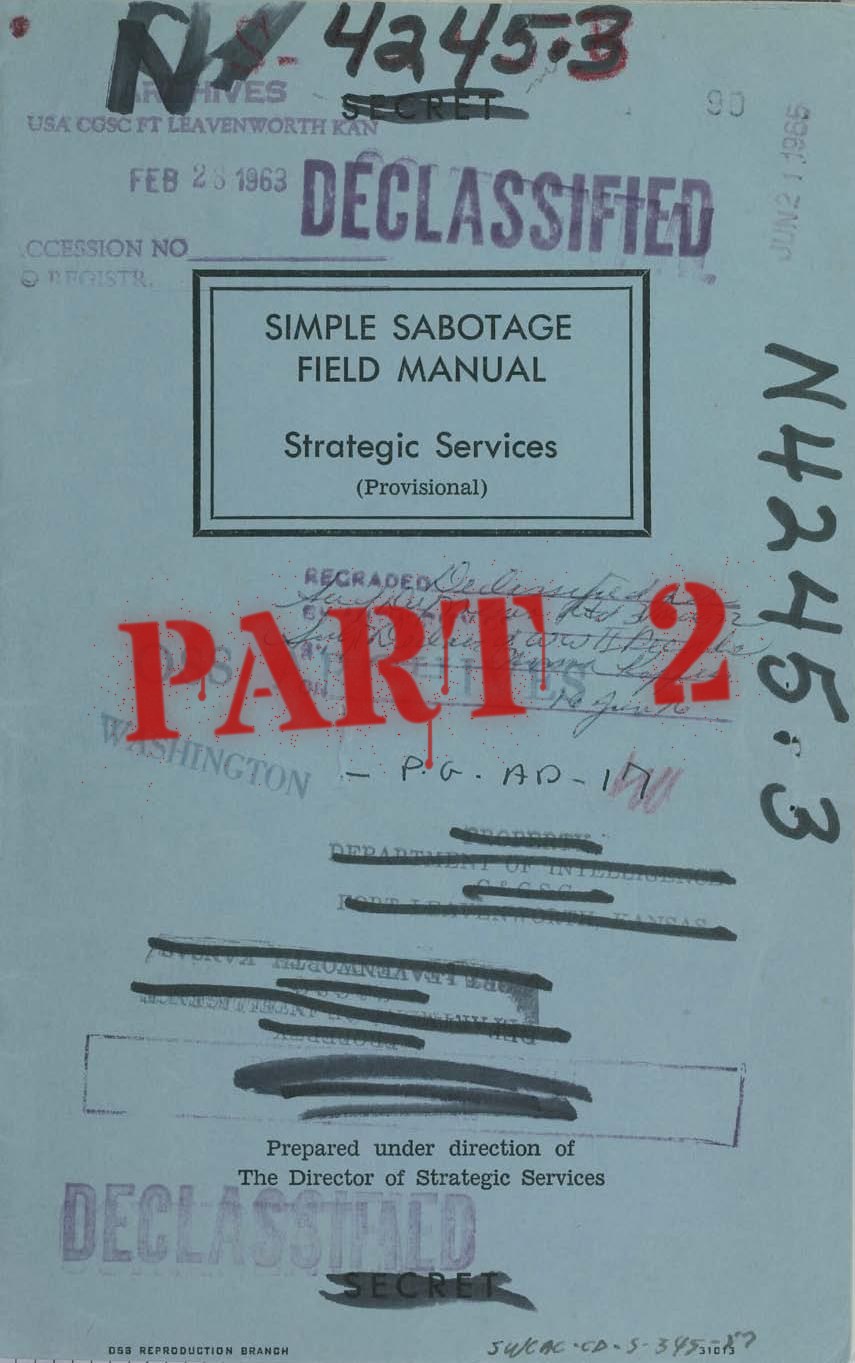
OSS Simple Sabotage Field Manual, part 2 of 7
Also on Spotify, Apple Podcasts, YouTube
Part 2 of 7. Picks up where part 1 left off.
From OSS Simple Sabotage Field Manual. Out Nov 17, 2026.
Read the transcript
Hello, and welcome back to Mic Check Stories. I'm your host, Brett Thorson, and tonight
we'll be continuing reading of the OSS Simple Sabotage Field Manual. OSS was the precursor
to the CIA, one of the places I used to work, and this manual was declassified a while
ago and makes for interesting reading. So in part two, we'll pick up on page four
and read through page seven.
Two, encouraging destructiveness. It should be pointed out to the saboteur where the
circumstances are suitable that he is acting in self-defense against the
enemy or retaliating against the enemy for other acts of destruction. A reasonable
amount of humor in the presentation of suggestions for simple sabotage will
relax tensions of fear. A, the saboteur may have to reverse his thinking, and he
should be told this in so many words. Where he formerly thought of keeping
his tools sharp, he should now let them grow dull. Surfaces that formerly
were lubricated now should be sanded. Normally diligent, he should now be
lazy and careless, and so on. Once he is encouraged to think backwards about
himself and the objects of his everyday life, the saboteur will see many
opportunities in his immediate environment which cannot possibly be seen from a
distance. A state of mind should be encouraged that anything can be
sabotaged. B, among the potential citizen saboteurs who are to engage in
physical destruction, two extreme types may be distinguished. On the one hand,
there is the man who is not technically trained and employed. This man needs
specific suggestions as to what he can and should destroy, as well as details
regarding the tools by means of which destruction is accomplished. C, at the
other extreme is the man who is a technician, such as a lathe operator or
an automobile mechanic. Presumably, this man would be able to devise methods of
simple sabotage which would be appropriate to his own facilities. However,
this man needs to be stimulated to reorient his thinking in the direction
of destruction. Specific examples which need not be from his own field should
accomplish this. D, various media may be used to disseminate suggestions and
information regarding simple sabotage. Among the media which may be used as the
immediate situation dictates are freedom stations or radio, false leaflets broadcast
or leaflets may be directed towards specific geographic or occupational
areas. Or they may be general in scope. Finally, agents may be trained in the
art of simple sabotage in anticipation of a time when they may be able to
communicate this information directly. Three, safety measures. A, the amount of
activity carried on by the saboteur will be governed not only by the number of
opportunities he sees, but also by the amount of danger he feels. Bad news travels
fast and simple sabotage will be discouraged if too many simple saboteurs
are arrested. B, it should not be difficult to prepare leaflets and other
media for the saboteur about the choice of weapons, time and targets which
will ensure the saboteur against detection and retaliation. Among such
suggestions might be the following. One, use materials which appear to be innocent.
A knife or a nail file can be carried normally on your person. Either is a
multi-purpose instrument for creating damage. Matches, pebbles, hair, salt,
nails, and dozens of other destructive agents can be carried or kept in your
living quarters without exciting any suspicion whatever. If you are a
worker in a particular trade or industry you can easily carry and keep
such things as wrenches, hammers, emery paper, and the like. Two, try to
commit acts for which large numbers of people could be responsible. For
instance, if you blow out the wiring in a factory at a central firebox, almost
anyone could have done it. On the street sabotage after dark such as you
might be able to carry out against a military car or truck is another
example of an act for which it would be impossible to blame you. Three, do
not be afraid to commit acts for which you might be blamed directly so long as
you do so rarely and as long as you have a plausible excuse. You dropped your
ranch across an electric circuit because an air raid had kept you up the
night before and you were half-dosing at work. Always be profuse in your
apologies. Frequently you can get away with such acts under the cover of
pretending stupidity, ignorance, over caution, fear of being suspected of
sabotage, or weakness and dullness due to undernourishment. Four, after you have
committed an act of easy sabotage resist any temptation to wait around and see
what happens. Loiterers arouse suspicion. Of course there are
circumstances when it would be suspicious for you to leave. If you
commit sabotage on your job you should naturally stay at your work. Section
four, tools, targets and timing. A, the citizen saboteur cannot be closely
controlled nor is it reasonable to expect that simple sabotage can be
precisely concentrated on specific types of target according to the
requirements of a concrete military situation. Attempts to control simple
sabotage according to developing military factors moreover might provide
the enemy with intelligence of more or less value in anticipating the date and
area of notably intensified or notably slackened military activity. B,
sabotage suggestions of course should be adapted to fit the area where they
are to be practiced. Target priorities for general types of situations
likewise can be specified for emphasis at the proper time by the underground
press, freedom stations and cooperating propaganda. One, under general
conditions. A, simple sabotage is more than malicious mischief and it should
always consist of acts whose results will be detrimental to the materials
and manpower of the enemy. B, the saboteur should be ingenious in using
his everyday equipment. All sorts of weapons will present themselves if he
looks at his surroundings in a different light. For example, emery dust, a
powerful weapon may at first seem unobtainable, but if the saboteur
were to pulverize an emery knife, sharpener or emery wheel with a hammer,
he would find himself with a plentiful supply. C, the saboteur should
never attack targets beyond his capacity or the capacity of his
instruments. An inexperienced person should not, for example, attempt to use
explosives but should confine himself to the use of matches or other familiar
weapons. D, the saboteur should try to damage only objects and materials known
to be in use by the enemy or to be destined for early use by the enemy.
It will be safe for him to assume that almost any product of heavy industry is
destined for enemy use and that the most efficient fuels and lubricants also
are destined for enemy use. Without special knowledge, however, it would be
undesirable for him to attempt destruction of food crops or food
products. E, although the citizen saboteur may rarely have access to
military objects, he should give those preference above all others.
Two, prior to a military offensive. During periods which are
quiescent in a military sense, such emphasis as can be given to simple
sabotage might well center on industrial production to lessen the
flow of materials and equipment to the enemy. Slashing a rubber tire on an
army truck may be an act of value. Spoiling a batch of rubber in the
production plant is an act of still more value. Three, during a military
offensive. A, most significant sabotage for an area which is or is soon
destined to be a theater of combat operations is that whose effects
will be direct and immediate. Even if the effects are relatively minor
and localized, this type of sabotage is to be preferred to
activities whose effects while widespread are indirect and
delayed. One, the saboteur should be encouraged to attack
transportation facilities of all kinds.
Well, thank you for spending your time with me as we read part
two of the OSS simple field sabotage simple sabotage field
manual. Declassified, of course. We have a few more parts coming
up. If you'd like to dedicate any of them, please check out our
links on miccheckstories.com. And I'd love to hear from you as
well. Until then, I'm Brett Thorson. Have a good night. Good
sleep.
U.S. government document. Public domain.