
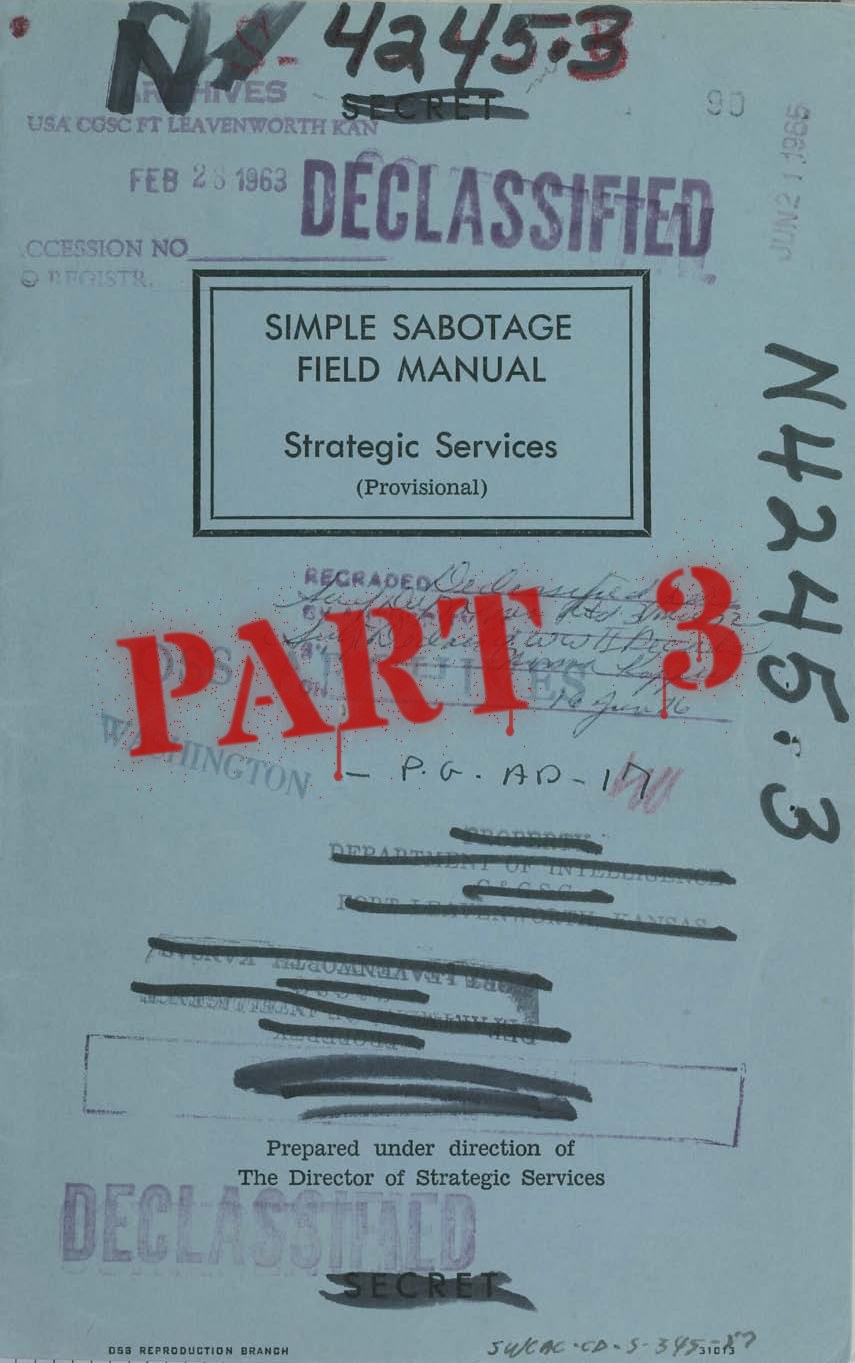
OSS Simple Sabotage Field Manual, part 3 of 7
Also on Spotify, Apple Podcasts, YouTube
Part 3 of 7. Picks up where part 2 left off.
From OSS Simple Sabotage Field Manual. Out Nov 20, 2026.
Read the transcript
Hello and welcome to Mike Check Stories. I'm your host Brett Thorson and tonight
we'll be continuing with part three of the OSS simple sabotage field manual from
1944. This was a booklet put out by the OSS, the Office of Strategic Services
precursor to the United States' CIA, Central Intelligence Agency, on how to
conduct simple sabotage. Reading it for a very interesting reason, as I was
working one of the gigs I was doing a consulting at and some of my
co-workers mentioned that one of the people was operating as if they had
taken ideas straight out of this manual. So we went to read it and sure
enough I've had a lot of good managers over the years and a few that seemed
to have read directly from this this manual. So that is why we're reading it
together. This is part three. Parts one and two of course are available Spotify,
YouTube, Apple podcasts. You can always check it out at MikeChecksStories.com
And now let's go to part three. We're gonna start on page eight of the simple
sabotage field manual from 1944. Among such facilities are roads, railroads,
automobiles, trucks, motorcycles, bicycles, trains, and trams. Two, any
communications facilities which can be used by the authorities to transmit
instructions or morale material should be the objects of simple sabotage. These
include telephone, telegraph, and power systems, radio, newspapers, placards, and
public notices. Three, critical materials. Valuable in themselves or necessary to
the efficient functioning of transportation and communication also
should become targets for the citizen's saboteur. These may include oil, gasoline,
tires, food, and water. Section five, specific suggestions for simple sabotage.
A, it will not be possible to evaluate the desirability of simple sabotage in an
area without having in mind rather specifically what individual acts and
results are embraced by the definition of simple sabotage. B, a listing of specific
acts follows, classified according to types of target. This list is presented as a
growing rather than a complete outline of the methods of simple sabotage. As new
techniques are developed or new fields explored, it will be elaborated and
expanded. One, buildings. Warehouses, barracks, offices, hotels, and factory
buildings are outstanding targets for simple sabotage. They are extremely
susceptible to damage, especially by fire. They offer opportunities to such
untrained people as janitors, charwoman, and casual visitors. And when damaged,
they present a relatively large handicap to the enemy. A, fires can be
started wherever there is an accumulation of inflammable material. Warehouses are
obviously the most promising targets, but incendiary sabotage need not be
confined to them alone. One, whenever possible, arrange to have the fire
start after you have gone away. Use a candle and paper combination, setting it
as close as possible to the inflammable material you want to burn. From a sheet
of paper, tear a strip three or four centimeters wide and wrap it around the
base of the candle two or three times. Twist more sheets of paper into loose
ropes and place them around the base of the candle. When the candle flame
reaches the encircling strip, it will be ignited and in turn will ignite the
surrounding paper. The size, heat, and duration of the resulting flame will
depend on how much paper you use and how much of it you can cramp in a small
space. Two, with a flame of this kind, do not attempt to ignite any but rather
inflammable materials such as cotton sacking. To light more resistant
materials, use a candle plus tightly rolled or twisted paper which has been
soaked in gasoline. To create a briefer, but even hotter flame, put celluloids
such as you might find in an old comb into a nest of plain or saturated
paper which is to be fired by a candle. Three, to make another type of simple
fuse, soak one end of a piece of string in grease, rub a generous pinch of
gunpowder over the inch of string where greasy string meets clean string, then
ignite the clean end of the string. It will burn slowly without a flame in much
the same way that a cigarette burns until it reaches the grease and gunpowder.
It will then flare up suddenly. The grease treated string will then burn
with a flame. The same effect may be achieved by using matches instead of
the grease and gunpowder. Run the string over the match heads taking
care that the string is not pressed or knotted. They too will produce a sudden
flame. The advantage of this type of fuse is that string burns at a set
speed. You can time your fire by the length and thickness of the string
you choose. Four, use a fuse such as the one suggested above to start
a fire in an office after hours. The destruction of records and other
types of documents would be a serious handicap to the enemy.
Five, in basements where waste is kept, janitors should accumulate oily
and greasy waste. Such waste sometimes ignites spontaneously, but it can
easily be lit with a cigarette or match. If you are a janitor on night
duty, you can be the first to report the fire, but don't report it too soon.
Six, a clean factory is not susceptible to fire, but a dirty one is.
Workers should be careless with refuse and janitors should be
inefficient in cleaning. If enough dirt and trash can be accumulated,
and otherwise fireproof building will become inflammable.
Seven, where illuminating gas is used in a room, which is vacant at night,
shut the windows tightly, turn on the gas and leave a candle burning in
the room, closing the door tightly behind you. After a time, the gas
will explode and a fire may or may not follow.
B, water and miscellaneous.
One, ruin warehouse stock by setting the automatic sprinkler system to work.
You can do this by tapping the sprinkler heads sharply with a hammer or
by holding a match under them.
Two, forget to provide paper in toilets. Put tightly rolled paper,
hair and other obstructions in the WC, water closet or
toilet. Saturate a sponge with a thick starch or sugar solution.
Squeeze it tightly into a ball, wrap it with string and dry.
Remove the string when fully dried. The sponge will be in the form of a
tight hard ball. Flush down a WC or otherwise introduce into a sewer line.
The sponge will gradually expand to its normal size and plug the sewage system.
Three, put a coin beneath a bulb in a public building during the daytime
so that fuses will blow out when lights are turned on at night.
The fuses themselves may be rendered ineffective by putting a coin behind
them or loading them with heavy wire. Then a short circuit may
either start a fire, damage transformers or blow out a central fuse
which will interrupt distribution of electricity to a large area.
Four, jam paper, bits of wood, hairpins and anything else that will
fit into the locks of all unguarded entrances to public buildings.
Two, industrial production, manufacturing. A, tools.
One, let cutting tools grow dull. They will be inefficient and will
slow down production and may damage the materials and parts you used them on.
Two, leave saws slightly twisted when you are not using them.
After a while, they will break when used.
Three, using a very rapid stroke will wear out a file before its time
so will dragging a file in slow strokes under heavy pressure.
Exert pressure on the backward stroke as well as the forward stroke.
Four, clean files by knocking them against the vice or the workpiece.
They are easily broken this way.
Five, bits and drills will snap under heavy pressure.
Six, you can put a press punch out of order by putting it in more material
than it is adjusted for. Two blanks instead of one for example.
Seven, power driven tools like pneumatic drills, riveters and so on
are never efficient when dirty.
Lubrication points and electric contacts can easily be fouled by
normal accumulations of dirt or the insertion of foreign matter.
Well, the thing I learned from this reading is I may be using files incorrectly.
Guess it's time to go look up some information on that.
And if there's something you've learned, hopefully for the positive,
we're just reading this for fun.
Let me know at mikecheckstories.com.
You can also go there to dedicate a page or a reading to yourself
or to someone you know who might be interested.
I'd also love to hear any feedback that you have as well.
Well, from Mike Check Stories, I'm Brett Thorson.
Thanks for coming along on this reading.
Have a good night. Good sleep.
U.S. government document. Public domain.